
You are using an out of date browser. It may not display this or other websites correctly.
You should upgrade or use an alternative browser.
You should upgrade or use an alternative browser.
NOT Hand Drawn/Hand Painted - Butterflies~ Due June 18 (non-Australians - May 21)
- Thread starter Donnacr
- Start date
More options
Who Replied?
Bloodofeve
Rookie
Can I join please?

Mailing today! I often do the cards before I sign up because then I know for sure I will be able to do it, so I actually worked on them over a couple of days and made 3 reject cardsAmai - great cards and very quick work! have you mailed yet or do you need my address?


ThouArtDelyrias
Thou Art Delyrias
ME! ME!!!
ThouArtDelyrias
Thou Art Delyrias
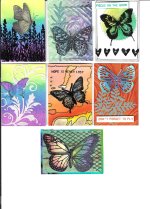
ThouArtDelyrias
Thou Art Delyrias
going out in todays mail!

I'm NOT signing up for this swap because I prefer to draw butterflies. However, I wanted to share what I learned at a nature journaling workshop yesterday. The presentation was by John Muir Laws, a prominent wildlife artist. You can look up his art on line. He pointed out that DEAD butterflies, especially those found as museum specimens, have the front wings held upward with the tips extending beyond the head. LIVING butterflies do not position themselves like that; instead when landing on plants, the upper wings are held straight across in aligment with the head. I have attached some photos for your reference. If you look up photos of butterflies on plants and see them with their wings held more forward than their heads, the photographer has probably positioned a dead butterfly on the plant before taking the photo. Often on these photos you can see the pin through the thorax where the person preserving the specimen has pinned down the dead butterfly. Here are some monarchs.
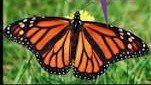 Living Monarch
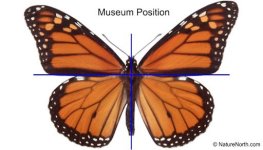 Dead Monarch
Living Monarch Dead Monarch
Last edited:

KerensaC
ATC Virtuoso
Wow, I didn’t know that! Thanks for sharing, Jo.I'm NOT signing up for this swap because I prefer to draw butterflies. However, I wanted to share what I learned at a nature journaling workshop yesterday. The presentation was by John Muir Laws, a prominent wildlife artist. You can look up his art on line. He pointed out that DEAD butterflies, especially those found as museum specimens, have wings held upward. LIVING butterflies do not position themselves like that; instead when landing on plants, the upper wings are held straight across in aligment with the head. I have attached some photos for your reference. If you look up photos of butterflies on plants and see them with their wings held in an upright position, the photographer has probably positioned a dead butterfly on the plant before taking the photo. Often on these photos you can see the pin through the thorax where the person preserving the specimen has pinnend down the dead butterfly. Here are some monarchs.
View attachment 827470 Living Monarch
View attachment 827471 Dead Monarch

jo.on.the.go - I didn't know about how they are displayed but I knew one of the ways to tell a moth from a butterfly was how they held their wings when at rest - a moth has their wings flat out while a butterfly generally holds their wings vertically above their body.
As a child I always thought that butterflies had pretty colours and designs while moths were the boring colours - I now know that this isn't always the case.
welcome MACE
As a child I always thought that butterflies had pretty colours and designs while moths were the boring colours - I now know that this isn't always the case.
welcome MACE

Wow, that is really cool information. Thank you for sharing that JoI'm NOT signing up for this swap because I prefer to draw butterflies. However, I wanted to share what I learned at a nature journaling workshop yesterday. The presentation was by John Muir Laws, a prominent wildlife artist. You can look up his art on line. He pointed out that DEAD butterflies, especially those found as museum specimens, have the front wings held upward with the tips extending beyond the head. LIVING butterflies do not position themselves like that; instead when landing on plants, the upper wings are held straight across in aligment with the head. I have attached some photos for your reference. If you look up photos of butterflies on plants and see them with their wings held more forward than their heads, the photographer has probably positioned a dead butterfly on the plant before taking the photo. Often on these photos you can see the pin through the thorax where the person preserving the specimen has pinned down the dead butterfly. Here are some monarchs.
View attachment 827470 Living Monarch
View attachment 827471 Dead Monarch
Yes, Donnacr, there is a difference between the way moths and butterflies often hold themselves. This is a monarch on a leaf with the wings held upright next to each other with the top surfaces touching each other and the underneath surfaces exposed. The bottom wings overlap part of the upper wings. The way they sit on plants as pictured in post #33 is less common. However, in nature they are not seen in the position noted in the second photo of post #33 (dead specimen) except very, very briefly when in flight, and at that time the inner edges of the lower wings are tucked downward. Below is a moth for comparison.
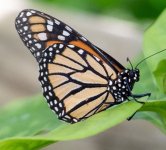 butterfly
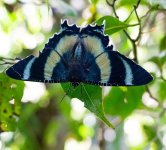 moth
moth
butterfly moth
Last edited:

I discovered that I cannot just cut out a butterfly. But I did remember how we used to have swaps using napkins. I think if I use a glue stick the images will stick. And I also looked in my forgotten printed tissue paper. Another good butterfly.
